
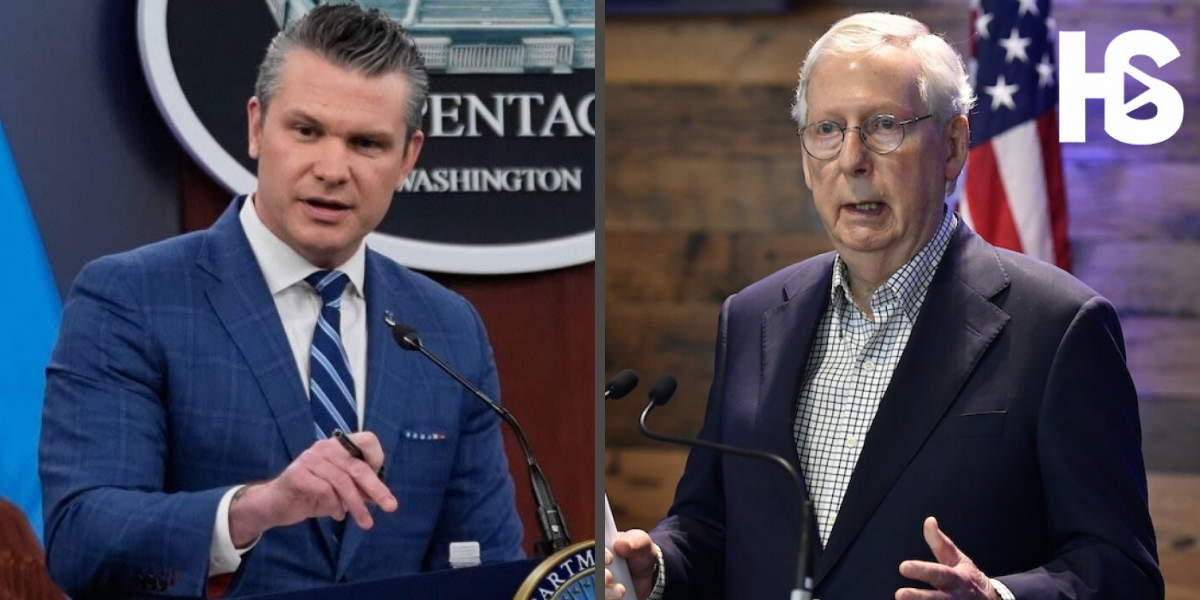
The mcconnell hegseth dispute centers on one of the most closely watched Republican disagreements over U.S. defense policy in recent years. Mitch McConnell voted against Pete Hegseth’s confirmation as Secretary of Defense on January 24, 2025, joining Republican senators Susan Collins and Lisa Murkowski. The Senate initially split 50–50, and Vice President JD Vance cast the deciding vote to confirm Hegseth, 51–50.
But the story did not end with the confirmation vote. Subsequent Senate hearings showed substantial differences between McConnell and Hegseth over Ukraine, Russia, NATO, American alliances, military spending, and defense priorities. Understanding those disagreements helps explain why the mcconnell hegseth relationship has attracted so much attention.
Why Did Mitch McConnell Vote Against Hegseth?
The mcconnell hegseth controversy began with McConnell’s decision to oppose Hegseth’s nomination. The final Senate record shows that McConnell was one of three Republican senators who voted “nay,” while the full Senate vote was tied at 50–50 before Vice President Vance broke the tie.
The significance of McConnell’s vote was not simply that he opposed a nominee from his own party. Hegseth’s confirmation became one of the rare Cabinet votes requiring a vice-presidential tie-breaker. The Senate’s official record confirms that Hegseth was ultimately confirmed on January 24, 2025, by 51 votes to 50.
| Key point | Confirmed detail |
|---|---|
| Nominee | Pete Hegseth |
| Position | Secretary of Defense |
| Confirmation date | January 24, 2025 |
| Initial Senate vote | 50–50 |
| Tie-breaking vote | Vice President JD Vance |
| Final result | Confirmed, 51–50 |
| Republican senators voting against | Mitch McConnell, Susan Collins, Lisa Murkowski |
McConnell Hegseth and the Ukraine Debate
A major part of the mcconnell hegseth story involves Ukraine and the war with Russia. McConnell has pressed Hegseth on what a successful outcome in Ukraine should look like and whether U.S. policy could allow Russia to determine the meaning of victory.
During a Senate hearing, McConnell challenged Hegseth over the implications of allowing Russia to define the outcome of the conflict. Hegseth responded that Ukrainians themselves would ultimately have to live with the result, while McConnell stressed that Ukraine should not be forced into accepting Russia’s preferred definition of victory.
This exchange illustrated a broader disagreement about American foreign-policy priorities. McConnell has emphasized the importance of U.S. credibility and support for allies, while Hegseth has defended the administration’s efforts to reassess American defense commitments and priorities.
How Ukraine Became a Major Point of Tension
The mcconnell hegseth disagreement is especially important because Ukraine represents a larger question about the role of American power overseas.
McConnell has argued that the United States has strategic interests in maintaining strong alliances and deterring aggression. His questions to Hegseth therefore focused not only on Ukraine itself but also on what U.S. decisions could signal to Russia and other potential adversaries.
For Hegseth, the Pentagon’s approach involves balancing support for partners with the administration’s broader assessment of American military resources and priorities. The difference between those approaches helps explain why McConnell has repeatedly pressed him during defense-related hearings.
McConnell Hegseth and NATO
Another major element of the mcconnell hegseth debate is NATO and America’s relationship with European allies.
McConnell has consistently emphasized the strategic value of alliances. His public remarks in 2026 continued to argue that American security is closely connected to European security and that confidence in U.S. commitments matters to allies.
That perspective creates tension with proposals that could create uncertainty around U.S. force posture or alliance commitments. McConnell’s concern is that weakening trust among allies could make deterrence more difficult, particularly at a time when European security remains a major U.S. national-security issue.
Defense Spending Adds Another Layer
The mcconnell hegseth relationship also includes disagreement over how the Pentagon should spend its resources.
McConnell has been directly involved in hearings examining the administration’s defense budget requests. The Senate Appropriations Committee held a June 2025 hearing reviewing President Trump’s fiscal year 2026 Defense Department budget request, with McConnell presiding and Hegseth appearing as a witness.
The debate is not simply about whether defense spending should increase. It is also about where the additional resources should go and whether the budget adequately supports military readiness, equipment, ammunition, emerging technologies and long-term deterrence.
What McConnell Questioned About Pentagon Priorities
During later budget discussions, McConnell continued to scrutinize Pentagon priorities rather than simply accepting higher spending as automatically beneficial.
His approach has focused heavily on practical military capability. In 2026, for example, McConnell questioned whether requested funding for drone and counter-drone capabilities was sufficiently built into the regular defense budget, while also emphasizing the value of cooperation with Ukraine and frontline NATO partners.
That helps put the mcconnell hegseth disagreement into context. McConnell can support higher defense spending while still demanding detailed explanations about how the money will improve U.S. military capabilities.
Is McConnell Against Hegseth Personally?
The available public record supports describing the relationship primarily as a policy disagreement rather than assuming a personal dispute.
McConnell’s vote against Hegseth was significant, but his later questions have concentrated on defense strategy, Ukraine, NATO, spending and military readiness. Those are substantive issues that can produce disagreements even between members of the same political party.
The mcconnell hegseth conflict is therefore better understood as a debate over policy direction than as simple partisan opposition.
Why the Hegseth Confirmation Vote Matters
The confirmation vote remains one of the most important facts in the mcconnell hegseth story because it demonstrated how divided the Senate was over Hegseth’s nomination.
The Senate’s official records show a 50–50 vote on the nomination, followed by Vice President Vance’s tie-breaking vote. The Senate’s daily record also specifically identifies McConnell, Collins and Murkowski as the Republican senators who voted against Hegseth.
That makes McConnell’s opposition particularly notable. Without the vice president’s vote, the nomination would not have received the Senate majority required for confirmation.
What the McConnell Hegseth Dispute Reveals
At its core, the mcconnell hegseth debate reflects competing views about how the United States should use military power.
McConnell’s position places strong emphasis on alliances, deterrence, support for partners such as Ukraine, and maintaining credible U.S. commitments. Hegseth’s defense agenda has focused on strengthening military capabilities while reassessing how resources and commitments are organized.
Those priorities can overlap, but they can also produce sharp disagreements over implementation.
The continued Senate questioning between McConnell and Hegseth shows that the debate is larger than one confirmation vote. It concerns the balance between domestic priorities, global commitments, defense spending and the strategic use of American military power.
Conclusion
The mcconnell hegseth story is fundamentally about a Republican senator challenging a Republican administration’s defense secretary over important questions of national security. McConnell’s vote against Hegseth helped produce a historic 50–50 confirmation vote, and his later questioning has highlighted disagreements over Ukraine, NATO, alliances and Pentagon spending.
Rather than being only a dispute between two politicians, the mcconnell hegseth debate reflects a broader argument over America’s role in the world and how its defense resources should be used.
Frequently Asked Questions
Why did Mitch McConnell vote against Pete Hegseth?
McConnell voted against Hegseth’s confirmation on January 24, 2025. The vote ended 50–50, after which Vice President JD Vance cast the deciding vote, confirming Hegseth 51–50.
Did McConnell and Hegseth disagree over Ukraine?
Yes. Their Senate exchanges included disagreement over how victory in the Russia-Ukraine war should be defined and what U.S. policy should communicate about support for Ukraine and resistance to Russian aggression.
Was McConnell the only Republican to oppose Hegseth?
No. McConnell joined Republican senators Susan Collins and Lisa Murkowski in voting against Hegseth’s confirmation.
How was Hegseth confirmed after the 50–50 vote?
Vice President JD Vance cast the tie-breaking vote. The Senate therefore recorded the nomination as confirmed, 51–50.